

Pakistan Chulah Cookstove. image courtesy Heritage Foundation of Pakistan

Architecture
how yasmeen lari turns survival into shared wisdom through reparative design
[RSS: www.designboom.com] the pakistani architect's humanitarian practice turns bamboo, earth, and community knowledge into a softer model for climate resilience. The post how yasmeen lari turns survival into shared wisdom through reparative design appeared first on designbo...
A
Admin
·
8 min read
·
7 views
Architecture
how yasmeen lari turns survival into shared wisdom through reparative design
[RSS: www.designboom.com] the pakistani architect's humanitarian practice turns bamboo, earth, and community knowledge into a softer model for climate resilience. The post how yasmeen lari turns survival into shared wisdom through reparative design appeared first on designbo...
A
Admin
·
8 min read
·
7 views
[RSS: www.designboom.com] the pakistani architect's humanitarian practice turns bamboo, earth, and community knowledge into a softer model for climate resilience. The post how yasmeen lari turns survival into shared wisdom through reparative design appeared first on designbo...
yasmeen lari’s architecture of repair
Architect Yasmeen Lari‘s practice is driven by the belief that design can help people rebuild their own worlds with the materials, skills, and knowledge already around them. Across bamboo shelters, earthen stoves, heritage conservation, community centers, and flood-resilient homes, the Pakistani architect has shaped a body of work that treats softness as action. It’s a way to reduce harm, share power, and harness architecture for climate resilience, social dignity, and collective repair.
In designboom’s 2025 interview from the Venice Architecture Biennale (read here), Lari described her bamboo community center for Qatar as ‘very welcoming,’ while also placing it within a wider ecological ethic: ‘it’s time we looked after the earth.‘ The phrase feels simple, but within her work it carries weight.
For Lari, design begins with the needs of people who have been displaced, underserved, or left to rebuild after climate disaster. It also extends beyond human comfort, toward a larger network of materials, land, animals, water, and repair.

Yasmeen Lari at the Qatar Pavilion, Venice Architecture Biennale, May 2025. image © designboom
from modernism to humanitarian practice
The career of architect Yasmeen Lari has moved through across several eras. Born in Pakistan in 1941, she studied architecture in the UK, returned to Karachi at 23, and established Lari Associates with her husband, Suhail Zaheer Lari.
Her early practice included housing, commercial buildings, and civic projects, while her long study of Pakistan’s historic towns and earthen traditions led to the founding of Heritage Foundation of Pakistan in 1980.
After retiring from conventional practice in 2000, she turned her attention to humanitarian work, especially after the 2005 earthquake and later floods in Pakistan. Since then, her architecture has become a system of shared knowledge, with communities trained to build with indigenous techniques, local labor, and low-carbon materials.
The shift is radical because it places architectural skill where it is often withheld: in villages, disaster zones, kitchens, courtyards, and self-built settlements.

The Juliet Center, Yasmeen Lari with Nyami Studio, Pono Village, Sindh, Pakistan. image courtesy Nyami Studio
barefoot social architecture
Yasmeen Lari calls this approach Barefoot Social Architecture, or BASA. It is a design philosophy based on co-building, local materials, carbon reduction, and self-reliance. Bamboo, mud, lime, thatch, terracotta, and palm matting become tools for dignity as much as construction. The architect’s hand remains present, though it works through instruction, prototypes, training manuals, and systems that can be repeated by the people who need them.
When she received the 2023 RIBA Royal Gold Medal (read here), Lari framed the recognition as a positive shift in the profession itself: ‘RIBA and the Award Committee have heralded a new direction for the profession, encouraging all architects to focus not only on the privileged but also humanity at large that suffers from disparities, conflicts and climate change.
‘There are innumerable opportunities to implement principles of circular economy, de-growth, transition design, eco urbanism, and what we call Barefoot Social Architecture (BASA) to achieve climate resilience, sustainability and eco justice in the world.‘

bamboo mosques designed for disassembly at Islamic Arts Biennale, Saudi Arabia, 2023. image courtesy of Islamic Arts Biennale
bamboo as shelter and social structure
That ethos is visible in the Lari Octa Green emergency shelters developed through Heritage Foundation of Pakistan (read here). The octagonal bamboo structures, lined with date palm matting and finished with conical thatched roofs, were created for flood relief and emergency rebuilding. Their geometry is direct and legible, allowing the system to be assembled quickly while offering more spatial grace than a temporary enclosure usually provides.
The shelters also show how Lari treats resilience as a social condition. A family gains a room, but also access to a building method that can be taught, adapted, and repaired. In that sense, the shelter is both object and instruction. It gives protection while passing along a form of agency, which may be the most important material in her work.
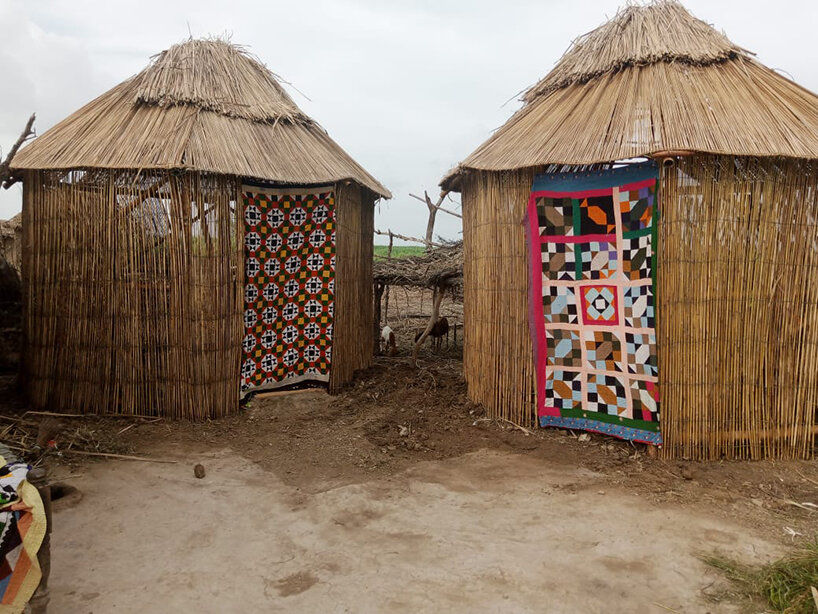
Lari Octa Green (LOG) emergency shelters, Pakistan, 2022. image courtesy Heritage Foundation of Pakistan
rebuilding after flood
Her ambition grew in scale after the devastating 2022 floods in Pakistan, which displaced millions of people and destroyed or damaged vast numbers of homes. Through Heritage Foundation of Pakistan, Lari set out to support the construction of flood-resilient homes using raised platforms, bamboo structures, lime-stabilized mud walls, thatch roofs, raised hand pumps, eco toilets, and Pakistan Chulah stoves.
While her work is gentle in its materials, it is firm in its politics. It refuses the idea that emergency architecture must be crude, imported, or disposable. A low-cost room can still hold proportion. A stove can shift health and gendered labor. A raised plinth can become the difference between repeated loss and a more secure return after water recedes.

Lari Octa Green (LOG) emergency shelters, Pakistan, 2022. image courtesy Heritage Foundation of Pakistan
the kitchen as climate infrastructure
The Pakistan Chulah, Lari’s raised earthen cooking stove, expands the scale of design into the household. It reduces smoke, lifts cooking from the ground, improves hygiene, and can be built with local materials. Within her wider framework, the stove carries the same architectural intelligence as a pavilion or shelter. It changes posture, air, labor, safety, and social pride.
This attention to domestic infrastructure gives her work its emotional force, as she does not treat architecture as an isolated building, finished at the edge of its walls. Her practice moves through water points, toilets, cooking platforms, shaded verandas, workshops, and community rooms. Each piece supports another. Each piece makes survival feel more possible and more dignified.

the architect harnesses heritage as a living toolkit
Heritage in architect Yasmeen Lari’s work is active. Through Heritage Foundation of Pakistan, she has worked with historic buildings, vernacular techniques, and conservation, yet her interest is never frozen in nostalgia. Earthen construction, bamboo joinery, lime, and craft traditions become contemporary tools for climate adaptation. The past is valuable because it can be used, shared, repaired, and taught again.
At Makli, where her Zero Carbon Cultural Centre has become a site for training and community exchange, that idea becomes architectural. Bamboo construction, prefabricated components, and local craft knowledge create a place where cultural preservation and future resilience sit together. The project suggests that heritage can serve those living with climate pressure now, through skills that belong to the place already.

Zero Carbon Cultural Centre, Makli, Pakistan, 2021. image courtesy Heritage Foundation of Pakistan
from village systems to venice
This is why the Venice pavilion matters. Qatar Museums notes that Lari’s Community Centre uses techniques first deployed through relief efforts by Heritage Foundation of Pakistan, bringing a humanitarian building model into the Giardini. The structure’s veranda, dome, and palm frond roof speak to hospitality, but also to the portability of knowledge across geographies.
The pavilion does the opposite of treating relief architecture as peripheral. It places bamboo, community construction, and flood-tested knowledge at the center of architectural conversation. In Venice, the work becomes cultural without losing its practical charge. It invites visitors to experience an architecture whose refinement comes from use, repetition, and care for people who build with their own hands.
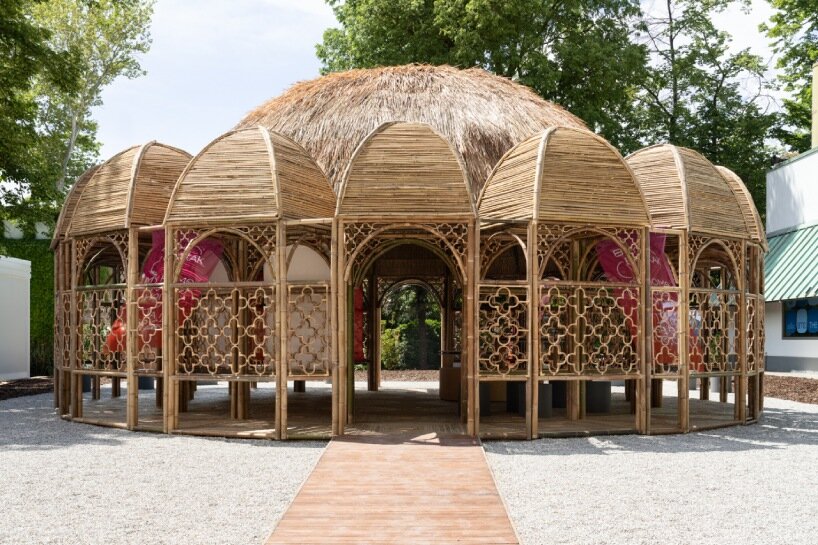
installation view of Yasmeen Lari’s Community Centre | image by Giuseppe Miotto / Marco Cappelletti Studio
an outlook shaped by eco justice
Across her body of work, Yasmeen Lari asks architects to give up some control in order to expand the industry’s reach. Her buildings and initiatives carry a strong formal identity, yet their deeper value lies in distribution. The design succeeds when others can copy it, repair it, teach it, and change it for their own ground conditions.
Her outlook feels especially urgent because it offers beauty without excess. Bamboo bends, mud cools, palm fronds shed rain, and a community learns how to continue. Lari’s architecture shows that softness can be exacting, practical, and deeply ambitious. It can be a pavilion in Venice, a stove in a rural kitchen, a raised room after a flood, or a shared method for rebuilding a world under pressure.
project info:
architect: Yasmeen Lari
The post how yasmeen lari turns survival into shared wisdom through reparative design appeared first on designboom | architecture & design magazine.
A
Admin
Editor
Comments (0)
No comments yet. Be the first to share your thoughts!